SQL stands for Structured Query Language. It is the standard language used to store, manage and retrieve data from relational databases.
SQL is not a programming language
Many beginners assume SQL is a programming language like Python or Java. It is not. Programming languages are used to build logic.
SQL does none of that. SQL is a scripting language. You describe what data you want and the database figures out how to get it for you.
In English you may say: Give me data of all orders which are delivered.
In SQL you just write: SELECT * FROM orders WHERE status = ‘delivered’;
How SQL works – thinking in English
The easiest way to learn SQL is to think of it as translating English questions into SQL queries. If you can ask a question in English, you can write it in SQL.
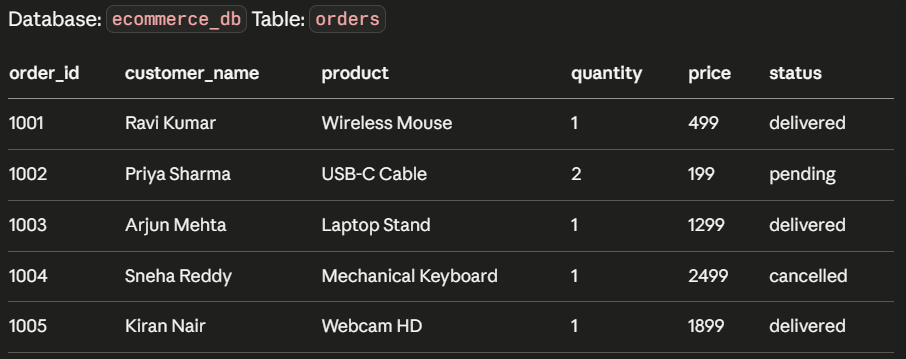
Lets see how the following questions are translated from English to SQL
- Show all orders
- SELECT * FROM orders;
The * means all columns. This query fetches every row and every column from the orders table.
- Show only the customer names and products
- SELECT customer_name, product FROM orders;
Instead of *, you selected the specific columns you want.
- Show only delivered orders
- Instead of *, you list the specific columns you want.
The WHERE clause filters rows based on a condition. Only rows where status is delivered are returned.
- How many orders are there in total?
- SELECT COUNT(*) FROM orders;
COUNT() counts the number of rows. This returns 5, a scaler number.
- What is the total revenue from all orders?
- SELECT SUM(price) FROM orders;
SUM() adds up all values in the price column and returns the total.
- Show orders sorted by price, highest first
- SELECT * FROM orders ORDER BY price DESC;
ORDER BY sorts the results. DESC means descending — highest to lowest.
These six examples cover the core of what SQL does. Every query you will ever write is some variation of these six queries. It’s all just fetch data, filter data, sort data, count it and calculate it.
As we go deeper into SQL, you will learn how to combine data from multiple tables using joins, perform calculations across rows using window functions, write reusable query blocks using CTEs, and handle complex data transformations using subqueries and aggregate functions. These are the concepts that separate a beginner from someone who can confidently handle real world data problems.