This is an introduction to SQL and SQL databases. You will learn about why SQL is important and how it helps you in your data career.
SQL is one skill you cannot skip if you work with data. SQL stands for Structured Query Language. It is the language used to talk to databases. It is used to store data, fetch it, update it and delete it as needed. Whether you are a data analyst, a BI developer or a backend engineer, you cannot escape from SQL as it shows up everywhere.
You do not need to be a programmer to learn SQL. You do not need a computer science degree to query data from a database. If you can ask a question in English, you can learn to write it in SQL. Look at the following SQL query that prints a boring ‘Hello World!’ statement.
SELECT 'Hello World!'
Here is another query that prints the same ‘Hello World!’ with ‘Greetings’ as its heading.
SELECT 'Hello World!' AS ‘Greetings’;
See, I told you it’s like learning English with different grammar rules.
This module is your starting point of learning SQL and practicing it as we learn. You do not need prior experience.
What is SQL and Why it matters
Almost every modern application stores data somewhere. Banking apps store transactions. E-commerce platforms store orders, products and customers data. Social media platforms store posts, likes, comments and followers.
All of this data lives in databases. And SQL is the language used to interact with that data.
- If you are a data analyst, you use SQL to pull reports and answer business questions.
- If you are a BI developer, you use SQL to build dashboards and data models.
- If you are a backend developer, you use SQL to read and write data from your applications.
SQL is not just one job’s skill, it is used across almost every data-related role.
What is a database and why do we use it?
A database is an organized collection of data. Think of it like a set of Excel spreadsheets, but far more powerful. Data inside a database is stored in tables. Each table has its own rows and columns
Rows are individual records and columns are the attributes of each record.
For example, an ecommerce database might have a table called orders.
Each row in that table is one order. The columns might be order_id, customer_name, product, quantity, price, and order_date.
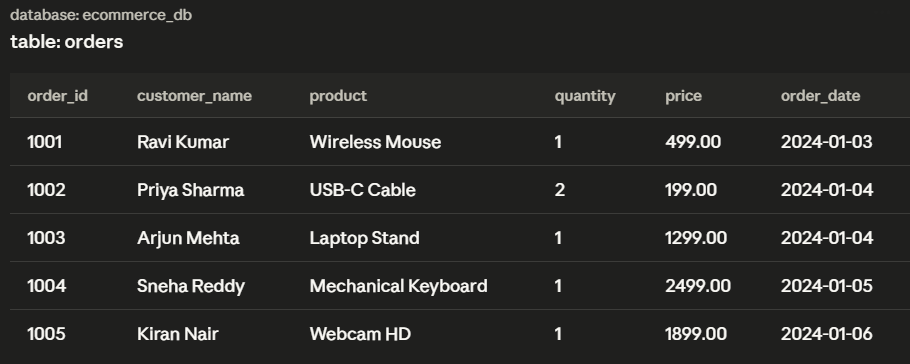
SQL is the language you use to work with these tables, to ask questions, to make changes and manage the data.
Why do we use databases
Imagine you run a small shop. You have 50 products, 100 customers and 200 orders. You could manage all of this in an Excel file as the numbers are small.
Now imagine you are Amazon. Millions of products, hundreds of millions of customers and thousands of orders every single minute. Excel cannot handle such numbers.
Databases are built to handle this. They can store millions of rows without slowing down. Multiple people can read and write data at the same time. Data stays accurate, consistent and safe even when something goes wrong. And you can ask complex questions across multiple tables in seconds.
This is why every serious application or business runs on a database.
Here is what this module covers:
What is SQL – You will understand what SQL is, why it exists, and how it works with a simple example. By the end, you will see that SQL is just a structured way of asking questions about data. You will also understand that SQL is not a programming language, it is a scripting language.
Popular SQL Databases – SQL runs on different database systems like MySQL, PostgreSQL, MS SQL Server and SQLite. You will understand what these are and what’s the difference between them.
SQL Sublanguages – SQL commands are grouped into five categories: DDL, DML, DQL, DCL and TCL. You will learn what each category is and commands we use in each category.
SQL Execution Order – When you write a query, SQL does not run it in the order you wrote it. It runs the query in the actual execution order that it follows. Understanding the actual execution order will save you from a lot of confusion later.
Start with the first topic and understand each one in order. Learn and understand every concept and practice the problems then and there itself.